The Story No One Wants to Star In
Nobody plans on ending up on the shoulder of I-70 with a dead engine, but that’s where one of our regular customers found himself last spring. His 2012 Honda Pilot had about 120,000 miles on it, and the timing belt was past due. He’d been meaning to get it done for months. The car ran fine, though, and life kept getting in the way.
Then one Tuesday morning on his way to work, the belt snapped. Here’s what happened next:
- His Pilot died while he was driving and would not restart.
- The Pilot’s 3.5L V6 is an interference engine, so the valves and pistons collided when the belt let go.
- The fix was a major engine repair that cost more than four times what a timing belt job would have.
He jokes now that procrastination is the most expensive hobby he’s ever had.
What Is This Little Belt Doing in There?
Most drivers know the timing belt is important without really knowing why. Here’s the short version:
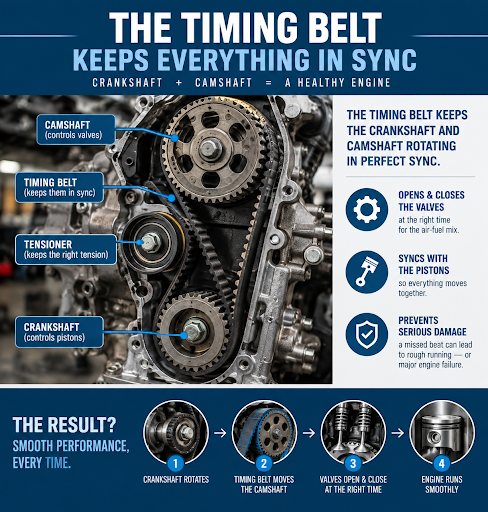
- It connects the crankshaft, which moves the pistons, to the camshafts, which open and close the valves.
- It keeps those parts turning in perfect sync, so every valve opens and closes at exactly the right moment.
- On a V6 like the one in the Honda Pilot, a single belt keeps both cylinder heads in time with the crankshaft.
If the belt slips even one tooth, the engine can run rough. If it breaks, the engine stops, and depending on how the engine is designed, the damage can be severe.
Interference vs. Non-Interference: The Distinction That Changes Everything
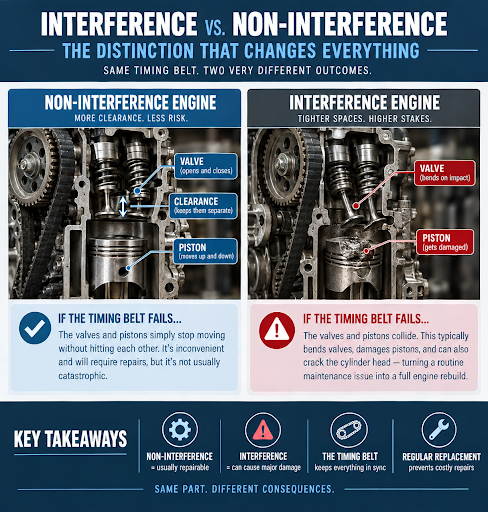
Engines fall into two groups, and the group yours is in decides how bad a broken belt gets.
- Non-interference engine: There’s enough room between the valves and pistons that they can’t touch. If the belt breaks, the engine stops, but the internal parts usually survive. It’s inconvenient, but it’s not usually catastrophic.
- Interference engine: The valves and pistons share the same space at different points in each rotation. If the belt breaks, they collide. That usually bends valves, damages pistons, and can crack the cylinder head.
The Honda Pilot’s 3.5L V6 is an interference engine, and Bernardi Honda’s timing belt guide notes that interference designs are common across Honda’s lineup. On these engines, a skipped belt job can turn routine maintenance into an engine rebuild or replacement.
Chances Are, You Don’t Know Which One You’ve Got
Most drivers have no idea which type of engine they have, and that’s exactly the problem. Many of today’s engines, especially smaller four-cylinders, are interference designs built for performance rather than forgiveness.
Not every engine has a timing belt, either. Many trucks and newer vehicles, including most Silverados, F-150s, and late-model Subarus, use a timing chain that’s designed to last much longer. Common Colorado vehicles that do use a timing belt include:
- Honda Pilot, Odyssey, and Ridgeline with the V6
- Older Subaru Foresters and Outbacks with the 2.5L engine
- Older Toyota 4Runners and Tacomas with the 3.4L V6
If you aren’t sure what’s under your hood, that uncertainty alone is reason enough not to stretch your belt past its recommended interval.
Those Mileage Numbers in Your Manual Aren’t Just Suggestions
Manufacturers don’t pull these intervals out of thin air. They’re based on testing of how the belt’s rubber and reinforcing cords break down from heat and age, even on a car that doesn’t see many miles.
- Most vehicles: Replace somewhere between 60,000 and 105,000 miles, depending on make, model, and engine.
- Honda Pilot: Every 105,000 miles or 7 years, whichever comes first.
- Your vehicle: The exact interval is in your owner’s manual, or we can look it up for you.
Age counts as much as mileage. A Pilot that only gets driven on weekends still needs a new belt at 7 years. Colorado’s altitude and big temperature swings add stress too. A belt that looks fine from the outside can be one road trip away from snapping.
The Signs Worth Paying Attention To
Watch for these warning signs before a worn belt turns into an engine rebuild:
- A ticking or slapping noise from the front of the engine
- Cracking, fraying, or missing teeth on the belt (on many engines, including the Pilot’s, the belt sits behind covers, so this one takes a technician to check)
- Oil or coolant leaking near the front of the engine, which can soak the belt and wear it out faster
- Misfires, rough running, or a check engine light
- An engine that cranks but won’t start
The catch is that timing belts often fail without any warning at all. That’s why mileage and age matter more than how the car feels today.
What Applewood Auto Service Can Do
This is the kind of maintenance where a quick check now saves a much bigger bill later. At Applewood Auto Service, we:
- Check your vehicle’s timing belt interval against your mileage and service history
- Tell you whether your engine is an interference or non-interference design
- Handle the replacement as one complete job when it’s due
We use OEM parts for timing belt jobs. On a Honda Pilot, that means genuine Honda parts for the belt, tensioner, idler pulleys, and water pump. OEM parts are built to the same specs as the originals, so they fit right and last the full interval. The water pump sits behind the timing belt and is driven by it, so replacing both at once means you don’t pay for the same labor twice. It also protects your cooling system, which matters more than most drivers realize. Every timing belt job is backed by our 3-year, 36,000-mile warranty.
If your paperwork says it’s time, don’t let this become the maintenance item you wish you’d taken care of. Stop by Applewood Auto Service in Wheat Ridge, and let us keep your engine’s timing exactly where it belongs.