If your car feels sluggish, hesitates, or struggles to start, you may be dealing with fuel‑delivery issues. But modern vehicles are not built the way they used to be and many drivers are surprised to learn that most late‑model cars no longer have a traditional, replaceable fuel filter.
In many modern vehicles, the fuel filter is integrated inside the fuel pump assembly, which sits inside the fuel tank. That means:
- The filter typically cannot be replaced separately
- A restriction often requires replacing the entire pump assembly
- Preventative maintenance is more important than ever
At Applewood Auto Service, serving drivers across Wheat Ridge and Arvada, we frequently diagnose and repair fuel‑system issues caused by contamination, carbon buildup, weak pumps, and internal filter restriction. Knowing the symptoms and how today’s systems work will help prevent costly repairs.
SIGNS TO WATCH FOR: SYMPTOMS OF FUEL RESTRICTION OR PUMP STRAIN
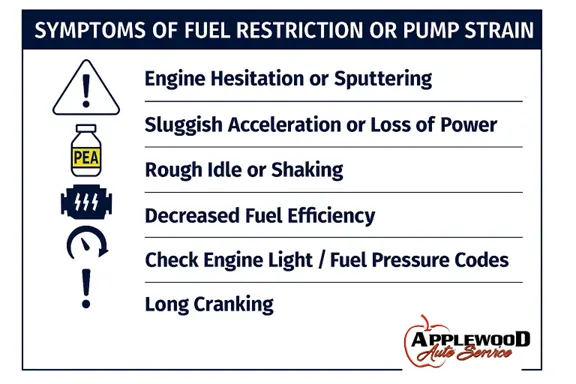
- Engine Hesitation, Sputtering, or Stalling
When your engine hesitates or sputters especially when accelerating it’s often the result of inconsistent or insufficient fuel flow. As a fuel pump begins to weaken, it struggles to maintain the steady pressure the engine needs. These pressure drops create brief loss of fuel and an over saturation of air that will cause conditions that make the engine stumble or surge. In more severe cases, the engine may momentarily lose power or even stall under load. These issues tend to show up more often in higher‑mileage early‑2010s crossovers and older compact sedans, where electric pumps and in‑tank filters are beginning to wear out.
- Sluggish Acceleration or Loss of Power
If your vehicle feels slow or unresponsive when you press the gas pedal, for example, when merging onto I‑70 or climbing a grade, it may be due to reduced fuel flow. The engine demands a surge of fuel during acceleration, and a restricted filter or tired pump simply can’t deliver the volume required. Drivers often describe this as “the car feels heavy” or “it just doesn’t want to go.” This tends to appear more frequently in older V8s and four cylinders with no turbocharger sedans and light‑duty pickups that need higher fuel volume to accelerate.
- Rough Idle or Shaking at Stoplights
A rough or vibrating idle can mean the fuel pump is unable to maintain precise, consistent pressure at low RPM. At idle, the engine runs on extremely fine calibrations, and any disruption in fuel flow leads to uneven combustion and shaking. This symptom is especially common in aging four‑cylinder daily drivers and mid‑2010s SUVs.
- Decreased Fuel Efficiency
Sudden or unexplained drops in MPG often indicate the engine is compensating for poor fuel flow. When fuel delivery is inconsistent, the engine may enrich the mixture to stabilize combustion which burns more gas. This is frequently seen long before more serious symptoms appear. It’s especially common in older compact SUVs and high‑mileage commuter sedans with partially restricted filters or aging pumps.
- Check Engine Light or Fuel Pressure‑Related Codes
Modern vehicles constantly monitor fuel pressure. If the pump is struggling or the in‑tank filter becomes restricted, the system can flag lean conditions, low‑pressure readings, or misfires all of which trigger the Check Engine Light. These alerts are especially common in midsize sedans and older crossovers.
- Hard Starts or Long Cranking Times
If your engine cranks for several seconds before starting especially after sitting overnight the pump may be losing the ability to build and hold fuel pressure. This is one of the earliest signs of pump deterioration. It’s most common in older trucks and larger engines, which require more fuel volume at startup.
WHY MODERN FUEL FILTERS CAN’T BE SERVICED SEPARATELY
Older vehicles used inexpensive, frame‑mounted or under‑hood filters that could be replaced in minutes. Modern cars often integrate the filter into the in‑tank pump module, meaning:
- You cannot replace the filter alone
- Debris buildup slowly chokes the pump over time
- The pump must work harder, overheating and wearing out
- Replacing the pump can require removal of the fuel tank
This is why proactive maintenance is essential.
HOW TO PREVENT FUEL PUMP & INTERNAL FILTER PROBLEMS
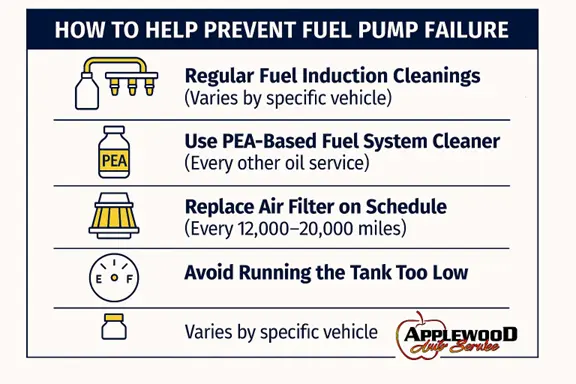
- Regular Fuel Induction Cleanings (Every 30,000–45,000 miles)
Fuel induction cleanings remove carbon buildup from:
- Intake valves
- Throttle bodies
- Injectors
Carbon deposits restrict airflow, distort fuel spray patterns, and increase the amount of work your fuel pump must do. When injectors clog, the pump must generate higher pressure to compensate, which significantly accelerates wear. A proper induction cleaning restores airflow and injector performance, helping prevent symptoms like sputtering, rough idle, hesitation, and low fuel pressure. This is especially valuable for direct‑injected engines, turbocharged vehicles, and high‑mileage vehicles. In some certain European applications, too much carbon build up has required replacement of the entire engine!
- Use High‑Quality Fuel + PEA‑Based Fuel System Cleaners (Every 3,000–5,000 miles)
Lower‑quality fuel contains fewer detergents and more contaminants. Over time, these contribute to injector clogging and internal filter restriction.
Polyetheramine (PEA) is the strongest and most effective detergent used in fuel cleaners because it:
- Survives high combustion temperatures
- Dissolves carbon deposits
- Cleans injectors, valves, and combustion chambers
- Restores fuel spray patterns
- Improves performance and MPG
These are going to be the in-tank additives and not a full system cleaner. This will help long term with less carbon build up inside of the engine and fuel systems to allow the full system cleaning work even better!
Wynn’s Premium Fuel System Cleaner uses this same chemistry at higher concentrations. It treats up to 15 gallons per bottle and is recommended every 3,000–5,000 miles.
- Replace Engine Air Filters on Schedule (Every 12,000–20,000 miles)
A clogged engine air filter reduces airflow. When this happens, the engine compensates by demanding more fuel, forcing the pump to work harder. This added strain accelerates internal filter clogging and reduces fuel efficiency.
- Avoid Running the Tank Too Low (Keep Above ¼ Tank)
Fuel cools and lubricates the electric fuel pump. Running the tank too low can overheat the pump and pull sediment from the tank bottom, rapidly clogging the internal filter. Keeping the tank above ¼ helps maintain pump health, fuel‑system cleanliness, and system cooling.
WHEN TO HAVE YOUR FUEL SYSTEM CHECKED
If your vehicle shows any of these symptoms such as hard starts, poor acceleration, rough idle, hesitation, reduced MPG, or a check‑engine light it’s time for a fuel‑system inspection.
At Applewood Auto Service, serving Wheat Ridge and Arvada, we offer:
- Fuel‑rail pressure testing
- Fuel induction cleanings
- Injector spray pattern evaluation
- Fuel pump electrical diagnostics
- Full drivability troubleshooting
FINAL THOUGHTS
Modern fuel systems are reliable but far less serviceable than older designs. A restricted internal fuel filter can slowly overwork your pump until it fails often without obvious warning. Recognizing symptoms early and maintaining the system with induction cleanings and PEA‑based treatments can extend pump life and improve performance by reducing carbon build up from fuel combustion. Applewood Auto Service in Wheat Ridge and Arvada is here to help.